Nitrogen for tyres offers a modest benefit: it leaks through rubber slightly more slowly than air and contains no moisture, so pressure stays a little more stable. Normal air is already about 78% nitrogen, so regular pressure checks matter far more than the gas you use, and nitrogen will not prevent blowouts on its own.
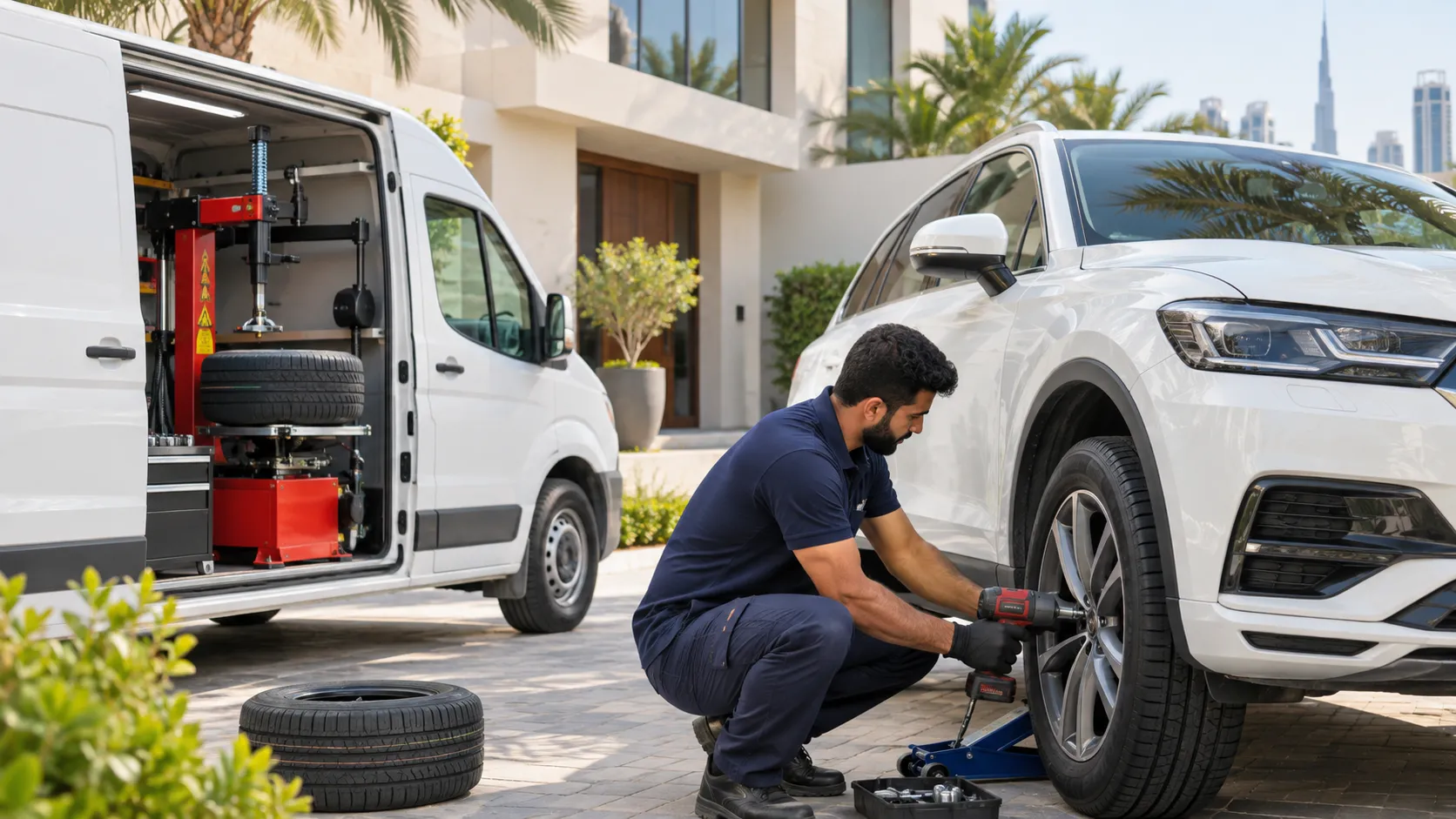
The honest answer first
Customers ask me about nitrogen for tyres almost every week, often because a petrol station or dealer has told them it is essential for the UAE summer. It is not essential. It is a small improvement that some drivers will notice and many will not.
Ordinary compressed air is roughly 78% nitrogen, 21% oxygen and a little water vapour and other gases. A typical nitrogen fill raises the nitrogen share to around 93–95%. You are not swapping one gas for something completely different; you are mostly removing oxygen and moisture.
That context matters when you hear big claims. Going from 78% to 95% nitrogen is a real change, but it is a change at the margins. The tyre still behaves like a tyre: it heats up, its pressure rises on a hot day and it slowly loses pressure over weeks.
Nitrogen gas for tyres vs air: side by side
Here is a fair comparison based on how each behaves in real cars, not on marketing claims.
| Factor | Compressed air | Nitrogen fill |
|---|---|---|
| Gas make-up | About 78% nitrogen, 21% oxygen, some moisture | Typically 93–95% nitrogen, very dry |
| Pressure loss over time | Normal, roughly 1–2 psi per month | Somewhat slower |
| Pressure change with heat | Rises with temperature | Rises with temperature almost exactly the same |
| Moisture inside tyre | Possible from wet compressors | Essentially none |
| Cost | Free or very cheap | Small charge per tyre, sometimes included with new tyres |
| Availability | Every petrol station | Selected tyre shops and service centres |
Myths I hear about nitrogen in the UAE
Several claims get repeated so often they are treated as fact. They do not hold up.
- Myth: nitrogen does not expand in heat. It does. All gases in a tyre follow almost the same pressure-temperature behaviour. A nitrogen-filled tyre still reads higher on a hot afternoon.
- Myth: nitrogen prevents blowouts. Blowouts come from underinflation, overloading, age, impact damage and heat build-up from flexing. Nitrogen does not fix any of those.
- Myth: you can never mix nitrogen and air. You can. Topping up a nitrogen tyre with air simply dilutes the purity. It is safe.
- Myth: green valve caps mean the tyre is still full of nitrogen. The cap only shows it was filled with nitrogen at some point.
Where nitrogen genuinely helps
Oxygen molecules pass through tyre rubber a little faster than nitrogen molecules. So a tyre filled with high-purity nitrogen loses pressure more slowly between checks. For a driver who rarely checks pressures, that slower drift is the most useful benefit.
Dry gas also means no water vapour inside the tyre. Moisture can make pressure swing a little more with temperature and, over a long time, contributes to corrosion of steel wheels and TPMS sensor parts. That is why aircraft, racing teams and some fleets use nitrogen: they want consistency, and they manage pressures very precisely.
For a fleet of delivery vans that only gets checked monthly, or a weekend car that sits for weeks in a hot villa garage, nitrogen can be a reasonable choice. For a daily driver who checks every couple of weeks, the difference is small.
Electric cars are sometimes sold with nitrogen as a must, because their tyres carry more weight and efficiency matters for range. The same logic applies: correct pressure is what protects range and tread, and nitrogen only helps by making that pressure drift a little more slowly.
What matters more than the gas
When I inspect tyres that have failed in the heat, the gas inside has never been the cause. These are the things that actually keep tyres alive in UAE summer.
- Correct cold pressure, checked every two weeks
- Tyres under five years old, ideally fitted fresh
- Working valve cores and caps that keep sand out
- No overloading on family trips or work pickups
- Prompt repair of slow punctures instead of repeated top-ups
- Wheel alignment that keeps wear even across the tread
If you choose nitrogen: how to do it properly
To get the full benefit the tyre needs to be purged, not just topped up. A single fill into a tyre that already contains air only gets you part of the way.
- Step 1: Ask for a purge fill: the tyre is deflated and refilled, ideally more than once, to raise purity.
- Step 2: Set the pressure to your door placard figure, just as you would with air.
- Step 3: Keep checking pressure every couple of weeks. Nitrogen tyres still lose pressure.
- Step 4: If you need a top-up and no nitrogen is nearby, use air. Correct pressure always beats gas purity.
My recommendation
If nitrogen is offered free with a new set of tyres, take it. There is no downside. If you are being charged for it as a standalone service with promises of safety and fuel savings, keep your money and buy a good digital pressure gauge instead.
A correctly inflated tyre filled with ordinary air is far safer than an underinflated tyre filled with nitrogen. That is the single message I wish every driver in the country heard before July.
What a nitrogen fill costs and what you actually get
Prices vary between petrol stations, tyre shops and dealers. Some include nitrogen free with every new tyre; others charge a few dirhams per tyre for a top-up, and dealers sometimes bundle it into a service package at a higher price. Whatever you pay, ask whether you are getting a full purge or just a top-up on top of existing air.
A quick top-up into a tyre that already holds ordinary air might only raise nitrogen content a few percentage points above the 78% that was there already. At that level, the difference to pressure retention is close to zero. If you are paying, a proper purge is the only version worth buying.
Nitrogen, TPMS sensors and alloy wheels
One genuine side benefit of dry gas is less moisture around the valve stem and the TPMS sensor inside the wheel. Water from wet compressors, combined with heat, can contribute to corrosion of the sensor body and the inside of steel wheels over many years. Alloy wheels are less affected, but corroded valve cores still cause slow leaks.
In practice, the sensor failures I replace in the UAE are mostly down to flat batteries after seven or eight years, physical damage during careless tyre changes, and sand-clogged valves. Nitrogen will not stop any of those. A valve cap and a fitter who knows how to break the bead without hitting the sensor will do more.
- Keep valve caps fitted, ideally plastic rather than metal, which can seize on aluminium valves
- Ask for the TPMS sensor position to be marked before the tyre is removed
- Replace valve seals or cores when you change tyres
Frequently asked questions
Is nitrogen better than air for tyres in hot weather?
Only slightly. Nitrogen loses pressure through the rubber a little more slowly and contains no moisture, but its pressure still rises in heat almost exactly like air.
Can I mix nitrogen and normal air in my tyres?
Yes, it is completely safe. Adding air just lowers the nitrogen purity, so correct pressure is always more important than which gas you use.
Does nitrogen prevent tyre blowouts?
No. Blowouts are caused by underinflation, overloading, age, impact damage and heat build-up. Nitrogen does not stop any of these on its own.
How often should nitrogen-filled tyres be checked?
Just as often as air-filled tyres, ideally every two weeks in summer. Nitrogen slows pressure loss slightly but does not stop it.
Does nitrogen improve fuel economy?
Only indirectly, by helping tyres stay closer to the correct pressure between checks. Keeping air-filled tyres at the right pressure gives the same benefit.
What do green valve caps on tyres mean?
Green caps are a common way of showing that a tyre was filled with nitrogen at some point. They do not tell you the current purity, and the tyre may since have been topped up with ordinary air, which is perfectly safe.
Is nitrogen gas for tyres worth paying for in Dubai?
If it comes free with new tyres, yes, take it. Paying separately is hard to justify for a daily driver who checks pressure regularly, because the benefit is small.
Faisal Imram has spent eight years fitting, repairing and diagnosing tyres across the UAE — from villa driveways in Arabian Ranches to hard shoulders on Sheikh Mohammed Bin Zayed Road. He leads the mobile tyre team at 800Sayara and writes our guides from what he sees on the job every day. More from Faisal.