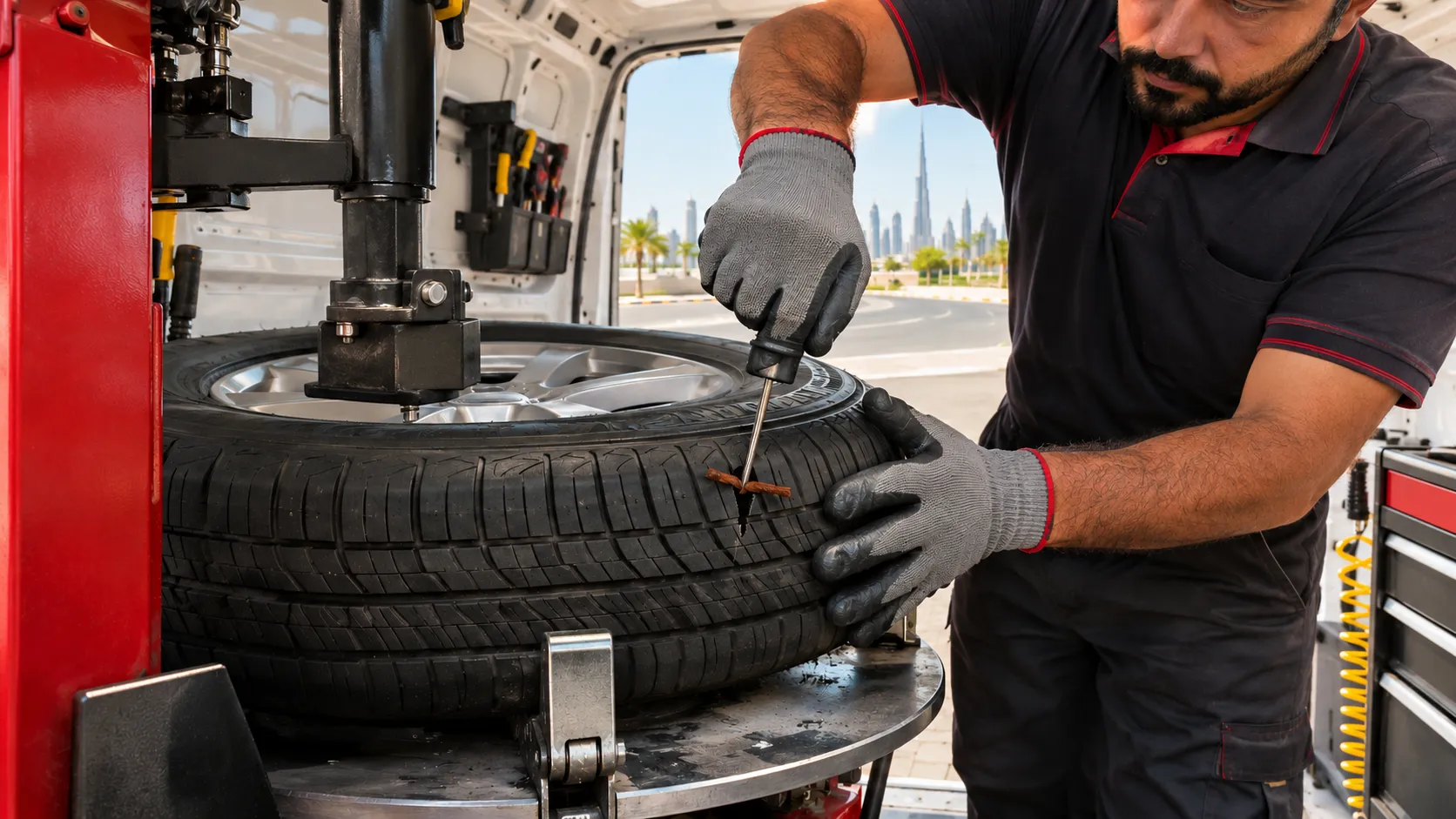
It costs from AED 59 per puncture and we do it wherever the car is parked. If the damage is in an area that cannot be repaired safely, we tell you straight away and show you why.
What's included
- Wheel removed and tyre demounted from the rim
- Inside inspection for hidden damage and rubber dust from running low
- Hole cleaned and reamed to remove damaged steel and rubber
- Inner liner buffed and cemented
- Plug-patch fitted through the hole and bonded to the liner
- Tyre remounted, inflated and leak tested
- Wheel rebalanced before refitting
What affects the final price
The starting price of AED 59 (per puncture, plug-patch repair) is the minimum you'll pay. It can go up with:
- Number of punctures in the same tyre
- Run-flat or low-profile tyres that are harder to demount
- Larger wheel sizes that need more balancing weight after the repair
- Whether a TPMS sensor needs a new valve core or seal
- Call-out timing and distance
Signs you need puncture repair
- A nail or screw visible in the tread
- Slow pressure loss of a few psi per week in one tyre
- TPMS warning showing one tyre consistently lower
- Hissing noise from a tyre after parking
- An old string plug that has started leaking again
How we do it on site
- Locate the punctureWe inflate the tyre and spray it with soapy water to find the leak, then mark it.
- Remove the tyreThe wheel goes on our changer and the tyre is taken off the rim so we can see inside.
- Inspect and prepareWe check the inner liner for damage, ream the hole and buff the surrounding area so the patch can bond.
- Fit the plug-patchThe stem of the plug-patch is pulled through to fill the hole, and the patch is rolled down onto the liner.
- Remount, balance, testThe tyre goes back on the rim, is balanced, inflated and tested again for leaks before refitting.
Which punctures can be repaired?
The tyre's tread area is reinforced by steel belts and can take a repair. The shoulder and sidewall flex constantly as the tyre rolls, so a repair there will not hold and the tyre must be replaced.
As a general rule, we repair holes up to about 6 mm in the central tread, away from the shoulders.
| Location / type | Repairable? | Reason |
|---|---|---|
| Central tread, hole up to ~6 mm | Yes | Belts support the repair |
| Shoulder (edge of tread) | No | Flexes too much; patch will fail |
| Sidewall | No | No belt support, high flex |
| Cut or gash over ~6 mm | No | Steel cords too damaged |
| Tyre driven while flat | Usually no | Inner sidewall damage |
| Two holes very close together | Usually no | Patches would overlap |
Plug-patch vs string plug
Many roadside shops push a sticky string plug into the hole from the outside without removing the tyre. It is quick, but nobody looks inside the tyre and moisture can reach the steel belts over time.
A plug-patch, sometimes called a mushroom plug, fills the hole and seals the inner liner from the inside. It is the method we use for every repair.
- String plug: outside-only, temporary, no internal inspection
- Plug-patch: tyre removed, hole filled and liner sealed, permanent repair
- If you already have a string plug, we can replace it with a plug-patch if the hole is still within limits
Run-flat and low-profile puncture repairs
Run-flat tyres can be repaired on the same rules, provided they have not been driven far at zero pressure. Running flat heats the reinforced sidewall and can damage it internally, so we inspect carefully and may advise replacement.
Low-profile tyres on 19–21 inch wheels are repaired the same way, but we take extra care on the changer to avoid marking the rim.
Puncture Repair FAQs
How much is a puncture repair in Dubai?
A plug-patch puncture repair starts from AED 59 per puncture. That includes demounting, inspecting, repairing, rebalancing and refitting the wheel.
Is a puncture repair safe for highway driving?
Yes, a properly fitted plug-patch in the central tread is a permanent repair and safe at normal highway speeds. It is not acceptable in the shoulder or sidewall.
How many times can a tyre be repaired?
There is no fixed number, but repairs must not overlap and should be spaced well apart. Tyres with several repairs close together are best replaced.
Can you repair a puncture near the edge of the tyre?
No. The shoulder flexes too much for a repair to last, so a puncture there means the tyre needs replacing.
What is the difference between a plug and a patch?
A plug fills the hole from outside, while a patch seals the inside liner. A plug-patch combines both, which is why it is the recommended repair.
Can a run-flat tyre be repaired?
Often yes, if the puncture is in the central tread and the tyre was not driven far without air. We inspect the inside first and advise if it should be replaced.
My tyre has a string plug. Is that okay?
It may hold for a while, but it is not considered a permanent repair. We can remove it and fit a plug-patch if the hole is still within repair limits.