Run flat tyres have reinforced sidewalls that support the car for a limited distance after losing pressure, typically around 80 km at up to 80 km/h, though you should check your owner manual. They are standard on many BMW and MINI models and some Mercedes-Benz models, cost more than normal tyres, and can only sometimes be repaired, depending on the tyre maker and whether the tyre was driven flat.
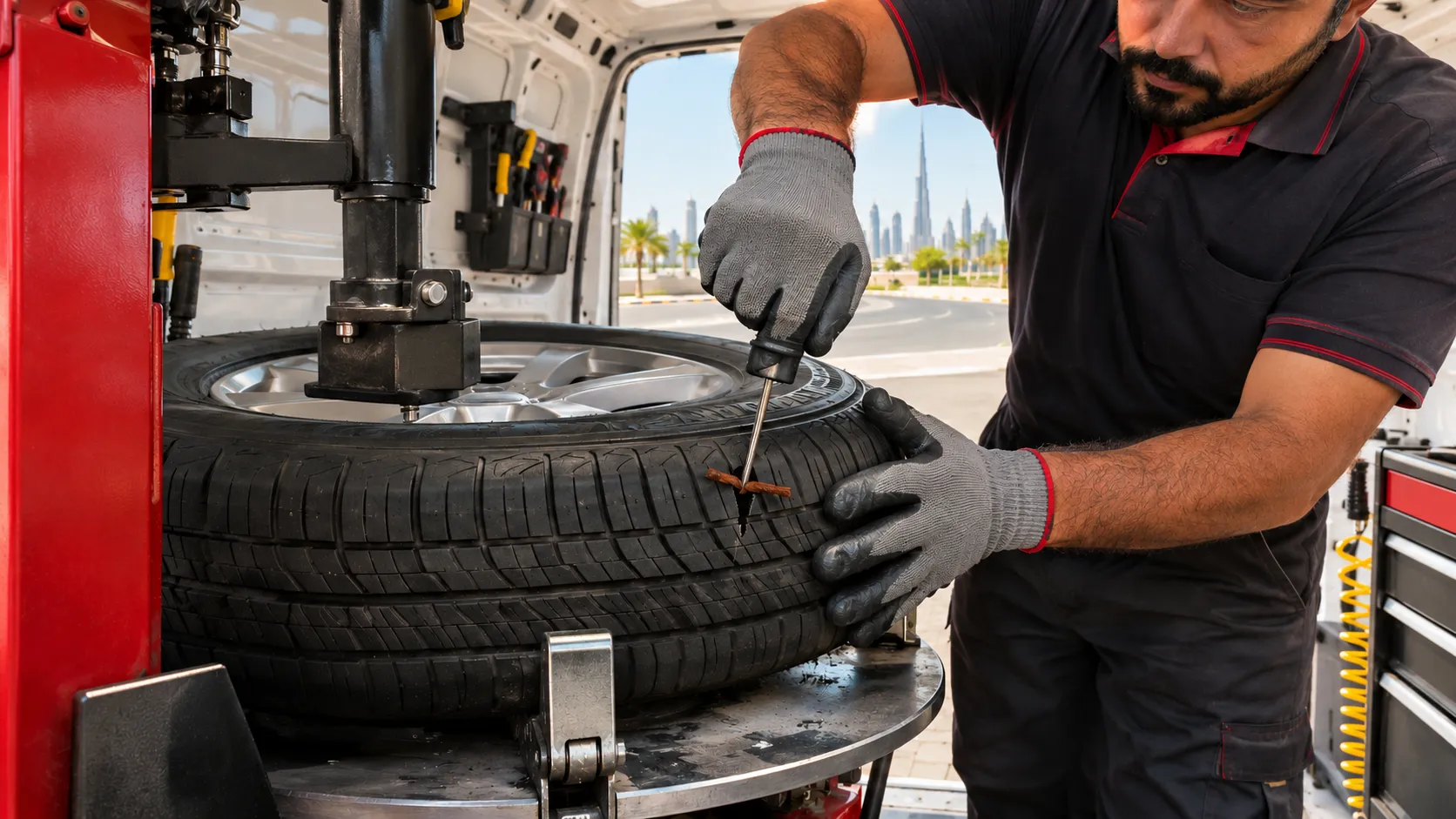
What run flat tyres are
A conventional tyre collapses when it loses air, because the air pressure is what holds the car up. Run flat tyres use stiff, reinforced sidewalls that can carry the weight of the car on their own for a limited distance. You get a warning from the tyre pressure monitor, and you can keep driving carefully to a safe place instead of changing a wheel on the hard shoulder of Emirates Road.
Every run-flat car must have a working TPMS. Because the tyre still looks almost normal with no air in it, you would not otherwise know you had a puncture until it was destroyed.
- Self-supporting run flats (the common type): stiff sidewalls do the work
- Support-ring systems: a ring inside the wheel carries the load; rare on UAE road cars
- Self-sealing tyres: not true run flats; a sealant layer closes small tread punctures
How to tell if your car has run flat tyres
Look on the sidewall. Each manufacturer uses its own marking, and BMW-approved tyres also carry a star symbol. If your car has no spare wheel and no sealant kit, that is another strong clue.
| Tyre maker | Run-flat marking |
|---|---|
| Bridgestone | RFT |
| Michelin | ZP (Zero Pressure) |
| Pirelli | Run Flat or r-f |
| Continental | SSR (Self-Supporting Runflat) |
| Goodyear | ROF or RunOnFlat |
| Dunlop | DSST or ROF |
| Hankook | HRS |
| Yokohama | ZPS |
Which cars use run flats in the UAE
BMW is the brand most associated with run flats here. Most 1, 2, 3, 4 and 5 Series cars and many X1, X3 and X5 variants left the factory on them, although some recent models have moved to conventional tyres with a sealant kit depending on trim. MINI uses them widely on the Cooper and Countryman.
Mercedes-Benz fits run flats to some C-Class, E-Class and SUV models, marked MOE for Mercedes Original Extended. Some Lexus, Infiniti and Kia models have also used them. Model years and trims vary, so the sidewall is always the final word.
Used-car buyers should pay attention here. I regularly meet BMW owners whose previous owner swapped the run flats for cheaper conventional tyres and left no sealant kit in the boot. They only find out on the day they get a puncture and discover there is nothing to fall back on.
Driving on a flat run flat tyre
Manufacturers typically quote around 80 km at a maximum of 80 km/h after a total loss of pressure, but this varies with load and conditions, so read your owner manual. In 45°C heat with a full car, I would treat those figures as an absolute ceiling rather than a target.
Use the distance to get somewhere safe or to meet a mobile fitter, not to finish your week of commuting. A run flat driven at highway speed with no air builds heat in the sidewall very quickly, and once the inner structure breaks down the tyre is scrap.
Can run flat tyres be repaired?
Sometimes. This is the area with most confusion. Some tyre makers allow a run flat to be repaired if it has not been driven in a deflated state, using the same rules as a normal tyre for hole size and position. Others, and some car makers, advise against repairing run flats at all. Policies differ, so we check the guidance for your specific tyre.
The practical problem is that most drivers do not know how far they drove after the warning came on. When we remove a run flat from the rim, we look for crumbling or discoloured rubber on the inner liner and creasing in the sidewall. If there is any sign it was driven flat, it is replaced. I would rather lose the repair job than send someone onto Sheikh Mohammed bin Zayed Road on a weakened tyre.
Run flat tyre prices in the UAE
Run flats cost more than standard tyres of the same size, and they are often in large rim sizes anyway. These are typical supplied-and-fitted ranges per tyre we see in the market; final prices depend on brand, size and stock.
Staggered cars, with wider rear tyres, need two different sizes, which limits stock and makes rotation impossible. Expect rear tyres on those cars to wear out roughly twice as fast as the fronts, so budget for rears more often.
| Size example | Typical car | Approx. price per tyre (fitted) |
|---|---|---|
| 195/55 R16 / 205/45 R17 | MINI Cooper | AED 650–1,100 |
| 225/45 R18 | BMW 3 Series | AED 900–1,500 |
| 245/45 R18 / 275/40 R18 | BMW 5 Series, staggered | AED 1,000–1,900 |
| 245/40 R19 / 275/35 R19 | BMW 4 Series, 5 Series M Sport | AED 1,200–2,200 |
| 275/40 R20 / 315/35 R20 | BMW X5, X6 | AED 1,500–2,800 |
Should you switch from run flats to normal tyres?
Plenty of BMW owners consider it, mainly for comfort and price. Run flats ride firmer and can be noisier, and the difference is noticeable on concrete expansion joints and speed bumps. Switching is possible, but think it through.
- You lose the ability to drive on after a puncture, and most run-flat cars have no space or mount for a spare.
- You will need to carry a sealant kit and compressor, or a space-saver if it fits.
- Suspension on some cars was tuned with run flats in mind, so handling can feel different.
- Do not mix run flats and normal tyres on the same axle.
- Ideally change all four at once so the car behaves consistently.
Fitting run flats: why the equipment matters
The stiff sidewalls that make run flats work also make them hard to fit. On a basic tyre machine, a technician can tear the bead or damage the wheel lip trying to force a cold run flat over the rim. In summer the rubber is softer and a bit easier to handle; in a cool basement in January it fights back.
Our vans carry tyre changers with a helper arm designed for run-flat and low-profile tyres, plus bead lubricant and a TPMS-safe procedure. The sensor sits right where the bead breaker would normally push, so we mark its position before starting. A damaged sensor on a BMW means a warning light and another bill, which nobody wants after paying for new tyres.
Looking after run flats in UAE conditions
Run flats hide low pressure well, which is exactly why they need more attention, not less. Because the sidewall holds its shape, a tyre that is 8 psi low looks fine from the driver seat. Only the gauge or the TPMS will tell you.
- Check pressures with a gauge every two weeks, even with TPMS fitted
- Reset or recalibrate the TPMS after any pressure change if your car requires it
- Avoid scraping kerbs; the stiff sidewall transmits impacts straight into the rim
- Have the inside of the tyre inspected after any warning, even if it seems to be holding air
Frequently asked questions
How far can you drive on a run flat tyre?
Typically around 80 km at up to 80 km/h after losing pressure, but this varies by tyre and load, so check your owner manual. In hot weather or with a full car, treat that as a maximum.
Can a run flat tyre be repaired?
Sometimes. It depends on the tyre maker's policy and whether the tyre was driven flat. If the inside shows any sign of running without pressure, it must be replaced.
Do all BMWs have run flat tyres?
Not all, but many BMW models sold in the UAE came with run flats as standard. Look for a star symbol plus RFT, ZP, SSR or similar markings on the sidewall.
Can I replace run flat tyres with normal tyres?
Yes, but you lose the ability to drive on after a puncture and usually have no spare. You should carry a sealant kit and change all four tyres together.
Why are run flat tyres more expensive?
Their reinforced sidewalls use more material and more complex construction, and they are often made in larger performance sizes. Fitting also needs care to avoid damaging the stiff bead.
Can I mix run flat and normal tyres?
Not on the same axle, and ideally not on the same car. The different sidewall stiffness changes handling and can confuse stability systems.
Faisal Imram has spent eight years fitting, repairing and diagnosing tyres across the UAE — from villa driveways in Arabian Ranches to hard shoulders on Sheikh Mohammed Bin Zayed Road. He leads the mobile tyre team at 800Sayara and writes our guides from what he sees on the job every day. More from Faisal.