The TPMS (tyre pressure monitoring system) warning light, a horseshoe shape with an exclamation mark, means one or more tyres has dropped well below the recommended pressure. If it stays on solid, check and inflate all tyres when cold. If it flashes for about a minute and then stays on, the system itself has a fault, usually a dead sensor battery or a sensor that wasn't programmed.
What is TPMS?
TPMS stands for tyre pressure monitoring system. It watches the pressure in your tyres and lights up a warning on the dash when one drops too low. The symbol is a cross-section of a tyre, which looks like a horseshoe, with an exclamation mark in the middle. Some cars also show the individual pressure of each tyre in the instrument cluster.
The system is there because people rarely notice a soft tyre by eye. A modern low-profile tyre can be 30% under-inflated and still look fine. In the UAE that matters more than in most places, because an under-inflated tyre running on summer tarmac at highway speed builds heat fast, and heat is what kills tyres.
Solid vs flashing: what the tyre pressure warning light is telling you
The most useful thing to know about the tyre pressure warning light is that it has two different modes, and they mean different things.
| What you see | What it means | What to do |
|---|---|---|
| Light comes on and stays solid | One or more tyres is significantly below the set pressure | Slow down, check all four tyres as soon as safely possible, inflate to the placard |
| Light flashes for 60–90 seconds at start-up, then stays solid | TPMS fault: sensor not reading, battery dead or sensor not programmed | Tyres may be fine; check them manually and book a sensor diagnosis |
| Light comes on suddenly while driving, with a pull | Rapid air loss, possible puncture | Hazards on, get off the road safely, do not keep driving at speed |
| Light comes on cold mornings, goes off after driving | Pressures are borderline low | Top up all tyres when cold to the recommended figure |
Direct vs indirect TPMS
There are two kinds of system, and which one your car has changes how it behaves and how we fix it.
Direct TPMS has a battery-powered sensor inside each wheel, usually attached to the valve. It measures actual pressure (and often temperature) and transmits it to the car. Most Japanese, Korean, American and German cars sold in the UAE use this. Indirect TPMS has no sensors in the wheels; it uses the ABS wheel-speed sensors to notice when one tyre is spinning faster because it has a smaller rolling diameter. Some Volkswagen group cars, some Mazdas and some Hondas use indirect systems.
| Direct TPMS | Indirect TPMS | |
|---|---|---|
| How it measures | Sensor inside each wheel | Compares wheel speeds via ABS |
| Shows individual pressures | Usually yes | Usually no |
| Detects all four going low equally | Yes | Often no |
| Battery to replace | Yes, sensors last roughly 5–10 years | No |
| After inflating or rotating | Some cars need a relearn | Must press reset / calibrate in the menu |
Why the light comes on in UAE conditions
Air pressure changes with temperature, roughly 1 psi for every 5–6°C. In January a car parked outside overnight in Al Ain or Hatta can see temperatures in the low teens, and the tyres that were set in a warm workshop at 35 psi read 31 or 32 by morning. That's often enough to trip the warning, and it goes off again once the tyres warm up.
In summer the opposite happens: pressures climb during the day, which masks a slow leak until the car cools at night. That's why I always tell people to set pressures cold, first thing in the morning or after the car has sat in the shade for a few hours, and never to let air out of hot tyres.
- Slow puncture from a nail or screw, the most common real cause.
- Leaking valve core or corroded valve stem.
- Bead leak on a corroded or kerbed alloy.
- Natural air loss over weeks (all tyres lose some pressure).
- Overnight temperature drop in winter.
- A sensor battery at the end of its life (flashing light).
- New wheels or a spare fitted without a programmed sensor (flashing light).
What to do when the TPMS light comes on
Here's the order I'd follow, whether you're in a villa community or stuck in traffic on Al Khail Road.
- 1. If the car pulls, vibrates or the light came on with a bang, stop safely and inspect. Don't drive on a visibly flat tyre.
- 2. If everything feels normal, drive gently to the nearest petrol station or home.
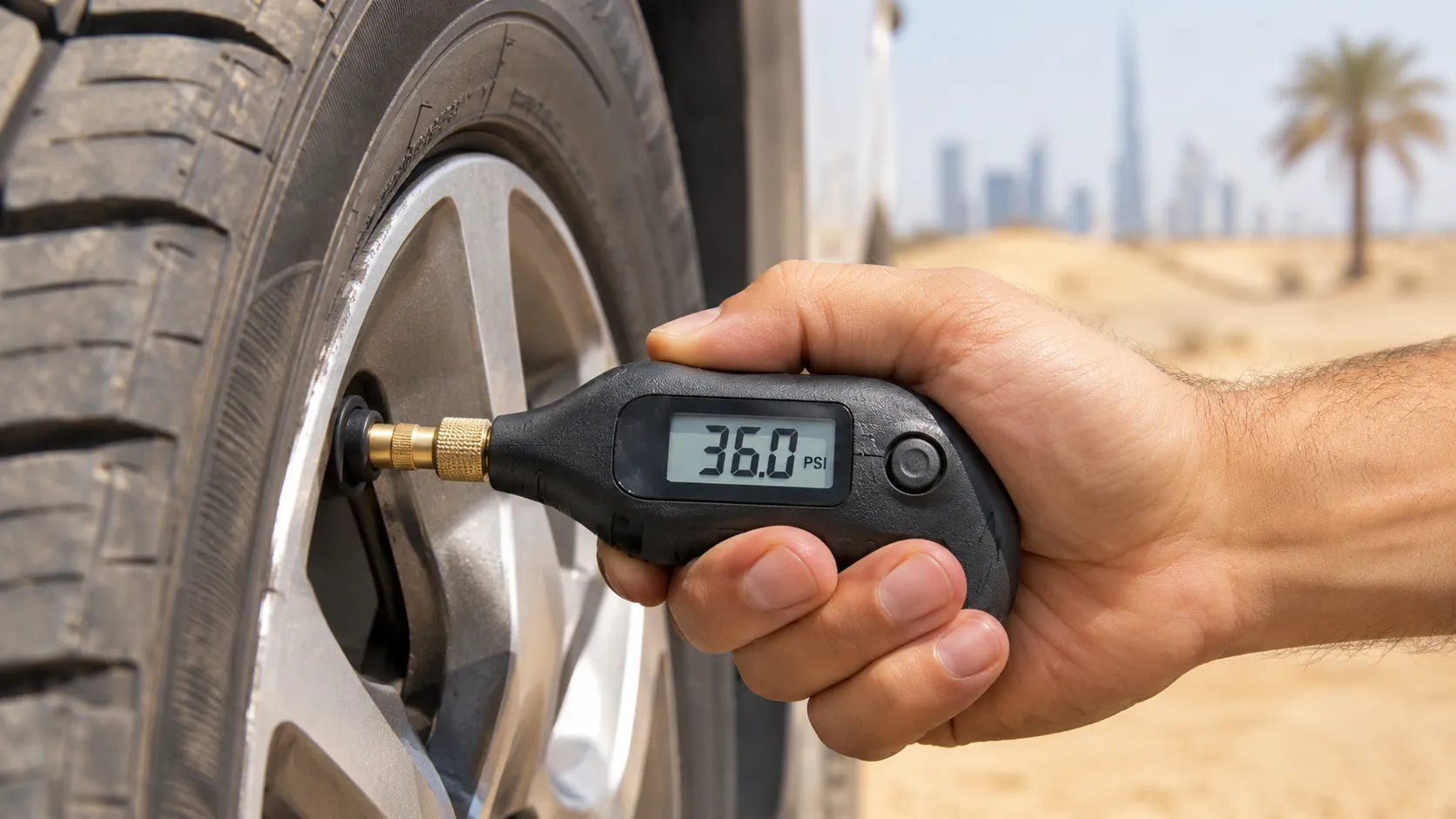
- 3. Check all four tyres with a gauge, plus the spare. Compare to the sticker on the driver's door pillar, not the maximum on the sidewall.
- 4. Inflate to the placard pressure. If the tyres are hot, add 2–3 psi above the cold figure and re-check later when cold.
- 5. Look for a nail, screw or cut on the low tyre. If one tyre keeps going down, get it repaired.
- 6. Drive a few kilometres. On most direct systems the light goes off on its own; on indirect systems, run the TPMS reset in the settings menu.
TPMS sensor faults and replacement
When the light flashes and then stays on, the car is telling you it can't hear one or more sensors. In my experience the number one cause on cars over six or seven years old is a flat sensor battery. The battery is sealed inside the unit, so the whole sensor is replaced.
The other common case is after someone fits new wheels or a set of winter or off-road rims without sensors, or after a cheap tyre shop broke a sensor while dismounting. We carry programmable sensors in the van and can clone the old ID or program a new one to the car on site. Our TPMS sensor replacement starts from AED 199 per sensor including programming.
TPMS after a tyre change, rotation or new wheels
A lot of TPMS lights I'm called about appear a day or two after someone else has worked on the car. Sometimes a sensor was cracked when the tyre was levered off, sometimes a valve nut was overtightened, and sometimes the car simply needs a relearn because the sensors have moved position. Cars that show individual pressures for each corner may display the right numbers on the wrong wheels after a rotation until they're relearned.
When we fit tyres, we take care with the sensor during mounting, fit new valve cores and seals where needed, and check every sensor is transmitting with a diagnostic tool before we leave. That last check takes a minute and avoids a warning light the next morning.
Can you drive with the TPMS light on?
With a solid light, you can drive carefully to a place where you can check the tyres, but you shouldn't ignore it for days. A tyre running 25% low on a summer highway is a genuine blowout risk. With a flashing fault light, the tyres themselves may be fine, but you've lost your early warning, so check pressures manually every week until it's fixed.
One more thing: a TPMS is not a replacement for a gauge. Most systems only warn when a tyre is already well below the correct pressure. Checking every two weeks keeps you ahead of it.
Frequently asked questions
What does the TPMS light mean?
It means the tyre pressure monitoring system has detected that one or more tyres is significantly under-inflated. Check and inflate all four tyres to the pressure on your door-pillar sticker when they are cold.
Why is my tyre pressure warning light flashing?
A light that flashes for about a minute after start-up and then stays on indicates a system fault rather than low pressure. The usual causes are a dead sensor battery, a damaged sensor, or a wheel fitted without a programmed sensor.
Why does my TPMS light come on in the morning and go off later?
Your pressures are borderline. Cooler night temperatures lower tyre pressure by about 1 psi for every 5–6°C, which trips the warning until driving warms the tyres up. Top them up to the recommended cold pressure.
How do I reset the TPMS light?
On most cars with direct TPMS, the light clears by itself after inflating and driving a few kilometres. Cars with indirect TPMS need a reset through the settings menu or a button, done after setting the correct pressures.
How long do TPMS sensors last?
Typically around 5 to 10 years, depending on the sensor and how often it transmits. The battery is sealed inside, so when it dies the sensor is replaced and programmed to the car.
Is it safe to drive with the TPMS light on?
It is safe to drive gently to a place where you can check the tyres, but not to ignore it. If the car feels normal, inflate the tyres as soon as possible; if it pulls or vibrates, stop and inspect.
Faisal Imram has spent eight years fitting, repairing and diagnosing tyres across the UAE — from villa driveways in Arabian Ranches to hard shoulders on Sheikh Mohammed Bin Zayed Road. He leads the mobile tyre team at 800Sayara and writes our guides from what he sees on the job every day. More from Faisal.