A tyre puncture can usually be repaired if the hole is in the central tread area, no larger than about 6 mm, and the tyre has not been driven flat. Punctures in the sidewall or shoulder cannot be safely repaired, and the tyre must be replaced; a proper repair uses an internal plug-patch fitted after removing the tyre from the wheel.
Nail in tyre: what to do first
A nail in tyre tread is the most common call we get from villa communities and construction-heavy areas like Dubai South and Al Furjan. The first rule is simple: if the nail or screw is still in the tyre, leave it there. It is often sealing the hole, and pulling it out can turn a slow leak into a flat in seconds.
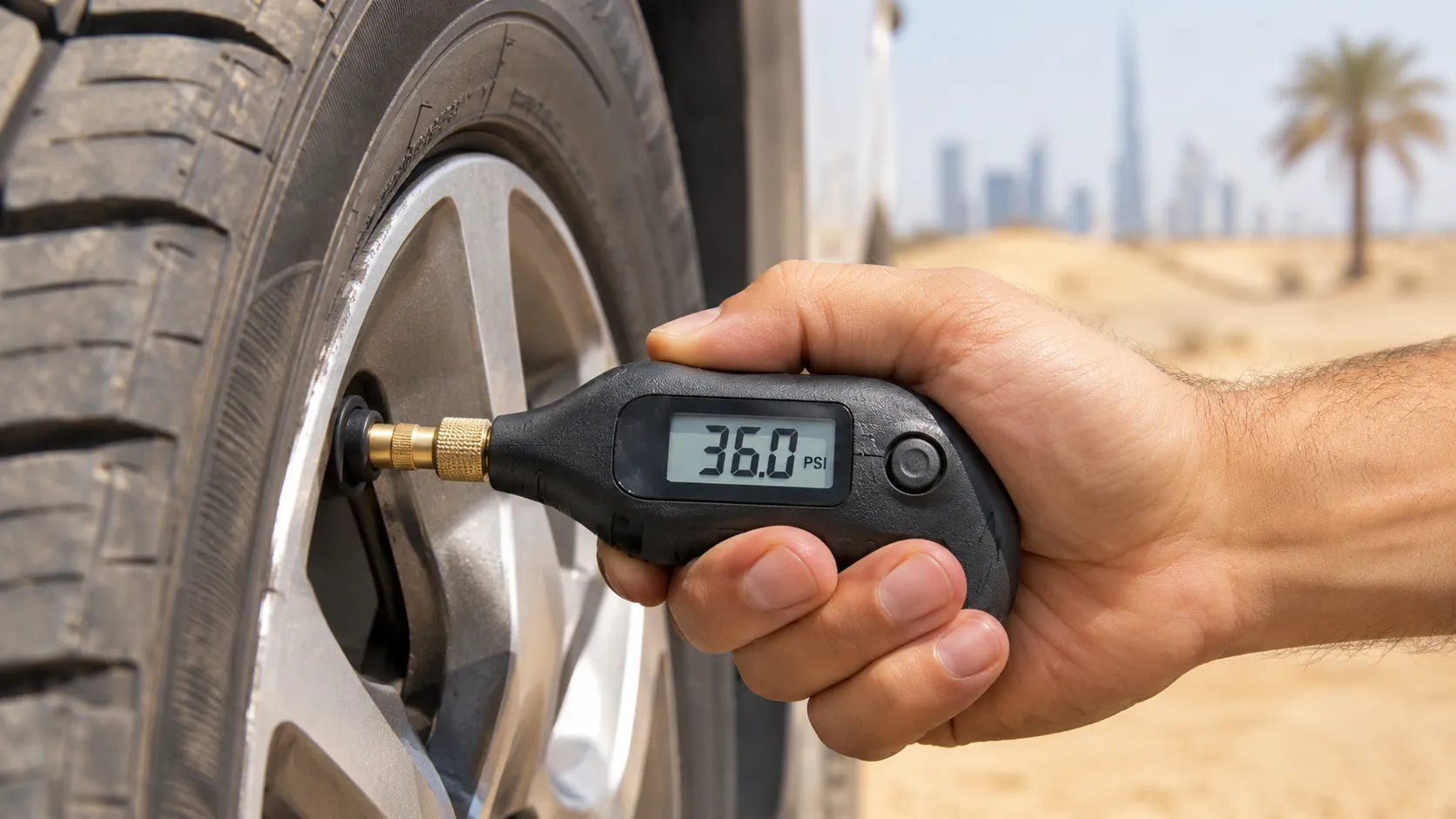
Check the pressure, top up if you can, and drive only as far as you need to at moderate speed, or call a mobile fitter to come to you. Driving a flat or very soft tyre even a short distance can ruin it beyond repair, because the sidewall gets crushed between the rim and the road.
If the tyre is already flat, do not drive on it at all. Put the hazards on, get passengers to a safe spot away from traffic, and either fit the spare or call for help. A tyre that could have been fixed for a modest fee becomes a full replacement after a kilometre on the rim.
Which punctures can be repaired
Whether a tyre puncture repair is safe depends on three things: where the hole is, how big it is, and what has happened to the inside of the tyre. Here is how I assess it on site.
| Damage | Repairable? | Why |
|---|---|---|
| Nail or screw in the central tread, up to about 6 mm | Usually yes | The tread area is reinforced by steel belts and a patch can seal it fully |
| Puncture near the shoulder edge | Usually no | The shoulder flexes heavily and a repair may not hold |
| Sidewall puncture or cut | No | The sidewall flexes constantly and carries the load, so a patch cannot restore its strength |
| Hole larger than about 6 mm or a long cut | No | Too much belt and cord damage |
| Any puncture after driving flat | Depends on internal damage | Running flat can shred the inner liner and sidewall |
| Puncture overlapping an old repair | No | Repairs must not overlap |
Why sidewall puncture repair is not safe
People are understandably frustrated when a tiny hole in the sidewall means buying a whole new tyre. But sidewall puncture repair is one job any responsible fitter will refuse. The sidewall is the part of the tyre that flexes with every rotation, and it carries the load of the car. A patch or plug there is working against constant movement and heat.
In UAE summer, with the tyre running hot at highway speed, a failed sidewall repair is not a slow leak. It is a sudden loss of pressure. I have seen sidewall plugs fitted by roadside shops that had worked themselves loose within weeks. If someone offers to plug your sidewall, say no.
Plug, patch or plug-patch: which repair is right
Not all puncture repairs are equal. The quick fix many people get is an external string plug pushed in from outside with the wheel still on the car. It is fast and can get you home, but it is not a permanent repair because nobody has checked the inside of the tyre.
The problem with skipping the inspection is that a nail can travel through the tread at an angle and scrape the inner liner for several centimetres. From outside, the hole looks tiny. From inside, I sometimes find a long tear or a liner that has started to separate, which would never have held a string plug for long.
- String plug (external): a temporary fix. Fitted without removing the tyre, so internal damage is never inspected.
- Patch only (internal): seals the inner liner but does not fill the hole, so moisture and grit can reach the steel belts.
- Plug-patch, sometimes called a mushroom repair (internal): fills the hole and seals the liner in one piece. This is the proper permanent repair.
How we repair a puncture properly: step by step
This is the process our technicians follow at your home or office. It takes roughly 30 to 45 minutes for a single tyre.
- Step 1: Locate the leak with soapy water and mark the position on the tread.
- Step 2: Remove the wheel and take the tyre off the rim on the van's tyre machine.
- Step 3: Inspect the inside for liner damage, cord damage or signs of running flat.
- Step 4: Clean and prepare the area, then drill the hole to the correct size for the plug-patch.
- Step 5: Pull the plug-patch through from inside and bond it to the liner.
- Step 6: Remount, inflate to the correct pressure, check for leaks and balance the wheel.
- Step 7: Refit the wheel and torque the nuts to the manufacturer setting.
Tyre sealant and puncture kits
Many newer cars, especially European ones, come with a compressor and sealant kit instead of a spare. The sealant can get you off a busy road, but it coats the inside of the tyre and the TPMS sensor. Some fitters will refuse to repair a tyre full of sealant, and sensors sometimes need cleaning or replacing afterwards.
If you use a sealant kit, tell your fitter before they remove the tyre. We clean it out, inspect the damage and repair if the hole is in the repairable zone. Treat sealant as a get-you-moving tool only, and keep speed low until the tyre is properly repaired.
Limits on repairs
A tyre can usually take more than one repair over its life, provided the repairs are in the tread area and do not overlap. I would think twice about a tyre with three or more repairs, especially if it is getting near the end of its tread or its five-year age limit.
Some performance tyre manufacturers restrict repairs or say the tyre loses its original speed rating after a repair. If you drive a high-performance car, ask about the tyre maker's guidance before deciding. And for run-flat tyres the rules are different again, because of how they behave after being driven with no pressure.
Where UAE punctures come from
Over the years the pattern of where our puncture call-outs come from has become quite predictable. Areas with active building sites produce screws, roofing nails and metal offcuts that drift onto the roads. Industrial zones add metal swarf, and villa communities under renovation leave nails in the gutters along driveways.
Basement car parks are another hidden source. Sharp ramp edges, broken drain covers and loose kerb stones cause cuts on the shoulder and sidewall that are often mistaken for punctures. Those cuts are almost never repairable, which is why the position of the damage matters so much more than its size.
- Screws and nails in the centre tread: usually repairable
- Metal shards on the shoulder from industrial areas: often not repairable
- Kerb or ramp cuts on the sidewall: never repairable
- Slow leaks from the rim edge or valve: often fixable without a puncture repair at all
Frequently asked questions
Can a tyre with a nail in it be repaired?
Usually yes, if the nail is in the central tread area and the hole is no bigger than about 6 mm. Leave the nail in place until the tyre is inspected, as it often slows the leak.
Can a sidewall puncture be repaired?
No. The sidewall flexes constantly and carries the load, so a repair cannot restore its strength. A tyre with a sidewall puncture must be replaced.
How long does a tyre puncture repair last?
A proper internal plug-patch repair is permanent and should last the remaining life of the tyre. An external string plug is only a temporary fix until the tyre can be inspected and repaired properly.
Is it safe to drive with a nail in my tyre?
For a short distance at moderate speed, if the tyre is holding pressure. Check pressure, avoid the highway, and get it repaired as soon as possible to stop the hole and belts deteriorating.
How much does puncture repair cost in Dubai?
Our mobile plug-patch repair has a starting price of AED 59 per puncture. The final price depends on the vehicle, wheel size and whether balancing is needed.
Can you repair a tyre near the shoulder?
Usually not. The shoulder flexes heavily and repairs there are unreliable, so most punctures close to the edge of the tread mean a replacement tyre.
Faisal Imram has spent eight years fitting, repairing and diagnosing tyres across the UAE — from villa driveways in Arabian Ranches to hard shoulders on Sheikh Mohammed Bin Zayed Road. He leads the mobile tyre team at 800Sayara and writes our guides from what he sees on the job every day. More from Faisal.