If you get a flat tyre, switch on your hazard lights, keep the steering straight, ease off the accelerator without braking hard, and move to the hard shoulder or the next exit. Get everyone out on the side away from traffic and stand behind the barrier. If the car is stuck in a live lane or anyone is hurt, call 999; otherwise call a mobile tyre service rather than changing the wheel next to fast traffic.
Flat tyre: what to do in the first ten seconds
I've been called out to hundreds of flats on Sheikh Zayed Road, Emirates Road and the E11 towards Abu Dhabi, and the cars that end up badly damaged are nearly always the ones where the driver panicked in the first few seconds. If you are wondering what to do with a flat tyre at 110 km/h, the answer is: very little, and smoothly.
You'll feel it as a sudden pull to one side, a flapping or thumping noise, or the TPMS warning lighting up. On a rear tyre the back of the car can feel loose and floaty. Whatever the sensation, the first moves are the same.
- Grip the steering wheel firmly with both hands and keep the car pointing straight.
- Lift off the accelerator gradually. Do not stamp on the brake.
- Switch on your hazard lights straight away so the cars behind understand you are slowing.
- Check your mirrors and plan your route to the right-hand hard shoulder or the nearest exit.
Getting safely off a fast road
On most UAE highways the hard shoulder is on the right, but on some stretches there is a narrow shoulder on the left beside the central barrier too. The right side is almost always safer because it is wider and you can get out away from the traffic. Signal, move across one lane at a time, and let the car slow on its own.
Driving a short distance on a flat tyre at low speed to reach a safe place is fine. It will probably finish the tyre, but a tyre costs a few hundred dirhams and your safety is not negotiable. If an exit, petrol station or service road is less than a kilometre away, crawling there at 20–30 km/h with hazards on is often the better choice than stopping on a narrow shoulder.
| Where you are | Best option |
|---|---|
| Sheikh Zayed Road / E11, wide right shoulder | Stop as far right as possible, wheels turned away from traffic |
| Narrow left shoulder by the central barrier | Only if you cannot cross safely; stay in the car with belt on and call 999 |
| Exit or petrol station within about 1 km | Crawl there slowly with hazards on |
| Tunnel, bridge or flyover with no shoulder | Keep going slowly to the end if possible; if stuck, call 999 |
| Residential road or car park | Pull over normally; this is a routine job |
Once you've stopped: protecting yourself
The hard shoulder feels safe, but it isn't. Vehicles drift onto it, especially at night and in fog, and a parked car is a target. Once you have stopped, put the handbrake on, keep the hazards running and, if it's dark, leave your sidelights on.
Get everyone out through the doors on the side away from traffic, then walk behind the crash barrier and up-stream of the car if you can. Children and pets come with you. Place your warning triangle well behind the car if you can do it without walking in a live lane; UAE drivers are expected to carry one, so keep it somewhere you can reach.
- Never stand between your car and traffic, or directly behind the car.
- In summer, take water and phones with you. Standing outside at 45°C for 40 minutes is a real risk, especially for children and older passengers.
- If there is no barrier and nowhere safe to stand, stay inside with seatbelts on and call for help.
Who to call: 999, a tyre service, or your insurer
Call 999 if the car is stopped in a live lane, in a tunnel, if anyone is injured, or if you feel unsafe. The police deal with this routinely and can protect the scene. Dubai Police also has a non-emergency number, 901, for situations that are not urgent.
For a normal flat on the shoulder, call a mobile tyre service. When you call us, the fastest way to get help is to send your live location on WhatsApp, the tyre size from the sidewall (or a photo of it) and the make and model. Many insurance policies and new-car warranties also include roadside assistance, so check your policy card while you wait.
| Situation | Number |
|---|---|
| Emergency, injury or car stuck in traffic lane | 999 (Police) |
| Non-emergency police, Dubai | 901 |
| Mobile tyre fitting / flat tyre help (24/7 emergency) | Call or WhatsApp +971 50 834 3096 |
Should you change the tyre yourself?
On a quiet residential street, in a villa driveway or a car park, changing to the spare yourself is fine if you know how. On a highway shoulder I'd strongly advise against it. Kneeling at the wheel on the traffic side puts your body within a metre of vehicles doing 120 km/h, and jacks slip on soft or sandy shoulders.
Many newer cars don't even have a spare: they have a repair kit with sealant and a compressor, or run-flat tyres. Sealant can get you moving on a small tread puncture, but it won't help a torn sidewall and it makes a proper repair messier. Run-flats are designed to be driven at reduced speed, typically up to 80 km/h for about 80 km, but check your manual.
What happens when a mobile technician arrives
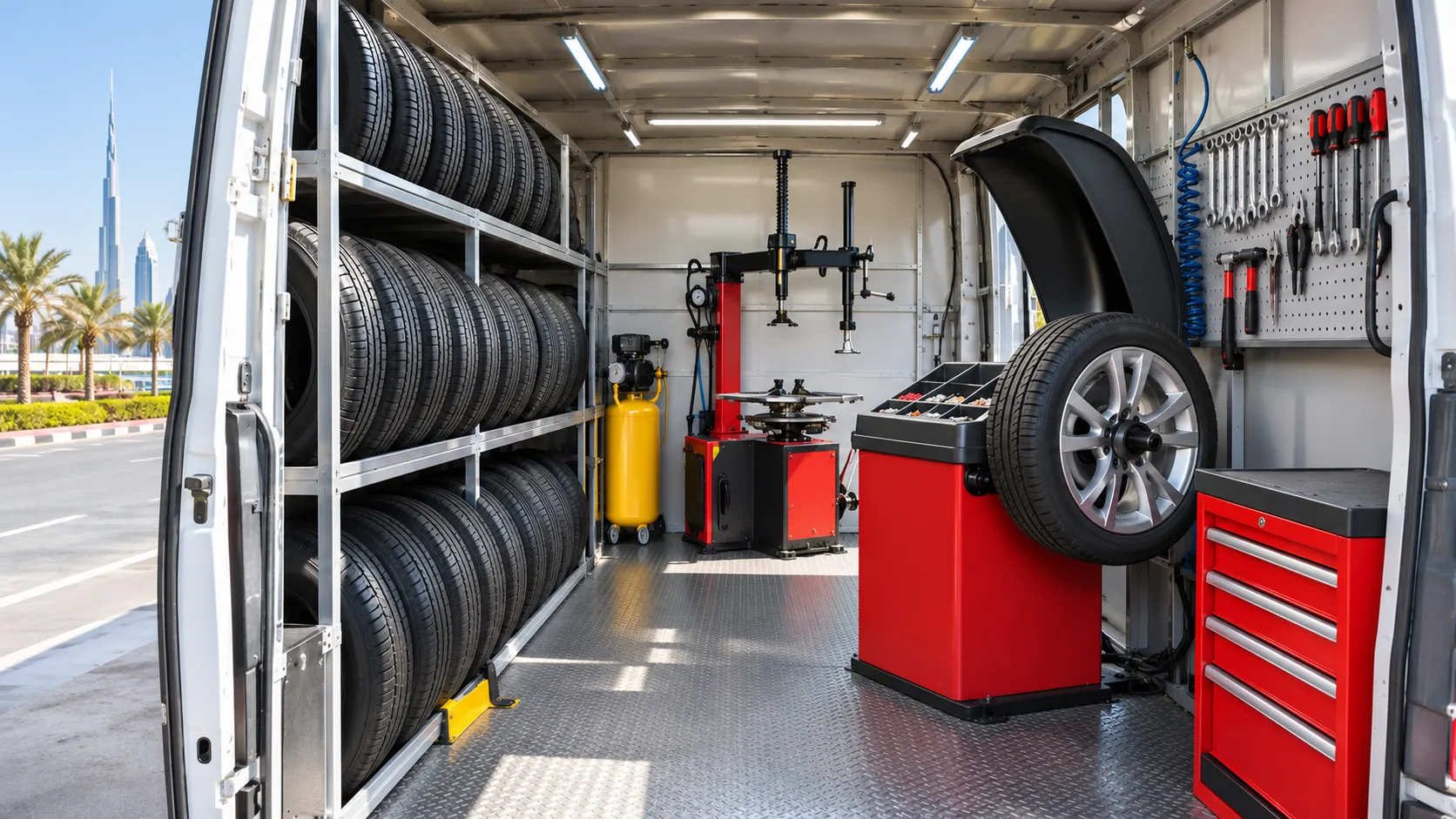
When I arrive at a highway job, the van goes behind the customer's car with beacons on, which gives us a protected work area. Then I check what we're dealing with. A nail in the centre of the tread can often be repaired; a cut sidewall or a tyre that was driven flat for several kilometres cannot.
- Assess the tyre: location and size of the damage, signs of driving flat (a grey powdery ring inside, sidewall creases).
- Decide: repair, fit your spare, or supply and fit a new tyre from the van stock.
- Fit and torque the wheel, set pressures on all tyres including the spare.
- If a temporary spare went on, arrange the permanent fix at your home or office later.
Preventing the next one
Most of the flats I attend on highways weren't sudden. The tyre had a slow leak for days, ran soft, overheated and failed. Checking pressures every two weeks, cold, and keeping an eye on the TPMS catches most of them early. In summer, underinflation plus 60°C tarmac is a bad combination.
Also check your spare. I lose count of the times I've arrived to find the spare flat too, or the jack missing. A two-minute check once a month saves a long wait at the roadside.
Frequently asked questions
What should I do first if I get a flat tyre on the highway?
Hold the steering straight, ease off the accelerator without braking hard, and turn on your hazard lights. Then move gradually to the right hard shoulder or the next exit and stop well away from traffic.
Is it safe to change a tyre on Sheikh Zayed Road?
It is not recommended. Working on the traffic side of a car on a highway shoulder is one of the riskiest things a driver can do, so get behind the barrier and call a tyre service or 999 if the car is in a dangerous spot.
Can I drive on a flat tyre to the next exit?
Yes, a short distance at very low speed with hazards on is acceptable to reach a safer place. The tyre will probably be damaged beyond repair, but that is better than stopping somewhere unsafe.
When should I call 999 for a flat tyre?
Call 999 if your car is stuck in a live lane, inside a tunnel or on a bridge with no shoulder, if anyone is hurt, or if you feel in danger. For a routine flat on a safe shoulder, a roadside or mobile tyre service is the right call.
How long does a mobile tyre service take to reach me?
We typically arrive in 30–60 minutes in central Dubai and 45–90 minutes in outer areas, depending on traffic. Sending your live location and tyre size on WhatsApp speeds things up.
Can a flat tyre be repaired at the roadside?
Often, yes, if the puncture is a nail or screw in the central tread and the tyre wasn't driven flat for long. Sidewall damage, large cuts or a tyre that has been run flat need replacing.
Faisal Imram has spent eight years fitting, repairing and diagnosing tyres across the UAE — from villa driveways in Arabian Ranches to hard shoulders on Sheikh Mohammed Bin Zayed Road. He leads the mobile tyre team at 800Sayara and writes our guides from what he sees on the job every day. More from Faisal.